Only Swimming Saves You From Drowning


It was a normal Tuesday when I almost drowned.
It all started in the morning. It was the most average of days you can imagine: laptop in front of me, with a cup of dark-brown anxiety juice in my hand. The task was easy: just create a new structure for a customer relationship management system (CRM).
Yes, I agree: not the most exciting task, but important. So I tried to get to work, but I was swept up by a flood of the most horrible questions out there: "what if..."
What if I chose the wrong approach? What if all the data got lost? What if I had to become a pro at CRMs?
I was barely keeping my head over the what-if-abyss, so I decided to also waterboard myself with information.
"Research. More research. The problem is that I don't know enough!"
Before long, it was 2pm, and I hadn't made one single decision.
But then, everything changed.
When I was about to lose my mind from the sheer number of approaches I could potentially take, I just took the first step into one of these directions.
"Alright, the deal stage process looks a little broken, let's fix that first. But what if—no keep going—the data structure looks alright, I'll just add some fields so we'll have more information about our customers. Let's go for the first test now, but what if—shut up—okay, all our customer data is still there and I didn't cause a nuclear fallout, what a time to be alive!"
After about thirty minutes, I had fixed the 20% that caused 80% of the problems.
This meme encapsulates it perfectly:
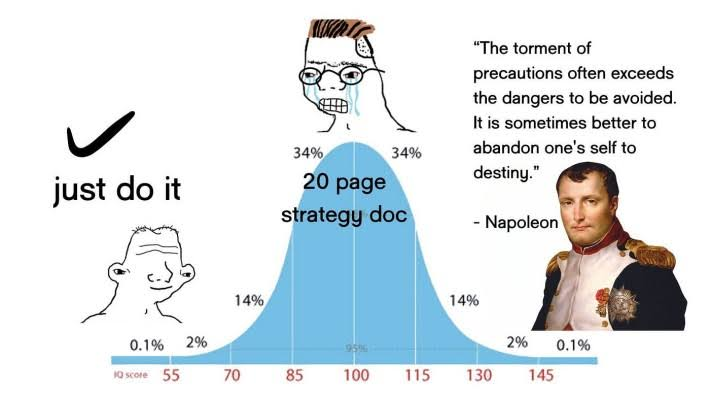
Thank you for your timeless wisdom, Napoleon. Find peace in the fact it became the slogan of the biggest sneaker brand on the planet.
The more I was captured by overthinking, the smaller my world got. The more I started taking action – interacting with the world – the bigger it became. Action causes expansion because it creates an explosion of possibility.
Imagine going down a river that flows down a linear path. You're on a boat, having the rudder in your hand. As long as you don't make a decision, the river will flow down in one way only. But when you take action – interacting with the world – magic happens: the river starts to grow more arms. These are different paths that open up to us when we start taking action. And don't forget: you also have the helm in your hand. So you can decide which arm of the river you want to go down. When your boat springs a leak, then jump off and start swimming, but don't stop.
This is the river of life. The less you interact with it, the more linear it will be. But the more chances you take, the more possibilities open up. Some people never interact with it at all – what a waste of water!
It seems it's because fear of failure is one of the great hindrances when it comes to taking action. Planning gives you the illusion of some kind of hedging against failure whilst also feeling productive. Yet when it comes to getting further ahead, there's no way around the big baddie reality. It's the feedback of reality we fear, because it's the only feedback where we can find truth. When we want to find out what really works, we must spring into action.
But we shouldn't mistake having an action bias as a free pass to be reckless. Taking action doesn't mean no thinking at all, but just the right amount (sometimes less is okay, too, as long as it makes you gain momentum). But thoughtless action can hurt ourselves or the people around us.
From my own experience, in the West we tend to make everything "heavy" when it comes to work. We have to carry the Puritan stone uphill, because if we'd arrive at the mountain top without any back pain, have we really carried enough – or so the fallacy goes. But making it seem like you're almost snapping your spine, even though the task doesn't require it, isn't more noble, but plain stupid (and a nightmare for health insurance companies). Just like Aldous Huxley said in his novel "Island":
“It’s dark because you’re trying too hard. […] Lightly, child, lightly. You’ve got to learn to do everything lightly. […] Yes, feel lightly, even though you’re feeling deeply. Just lightly let things happen and lightly cope with them.”
When we start to reframe the problem, we make it lighter. We trick our procrastination, which is nothing but fear in disguise. The more momentum we've gained, the easier it will be to keep going. That's when we will make the greatest progress – and it all started with one single step: taking action.