You Already Know What You Enjoy

An Evening to Remember
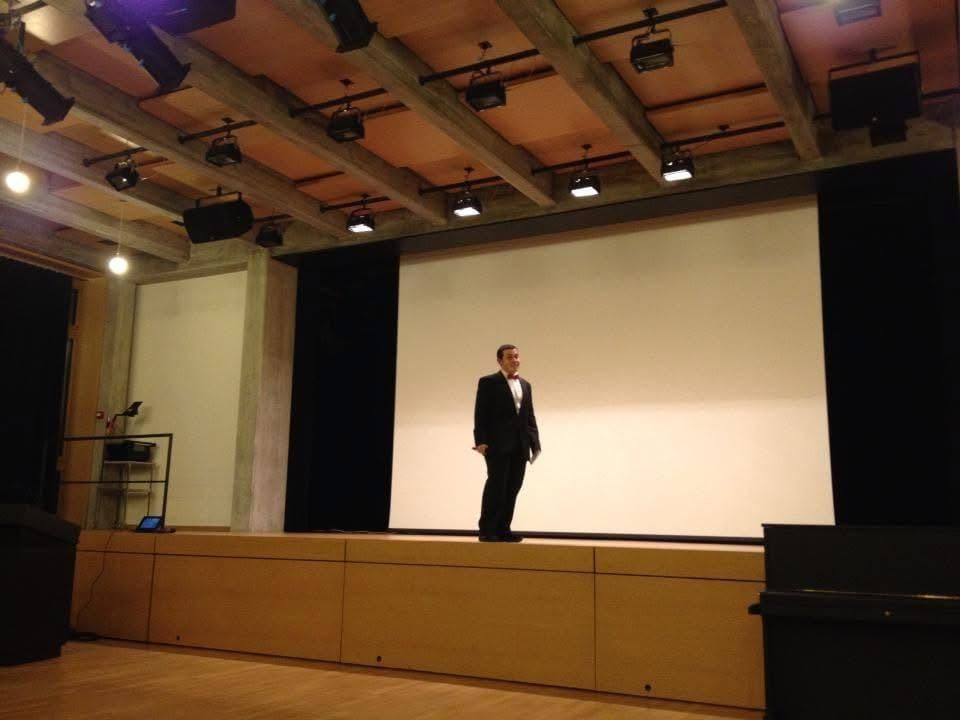
Noises. Noises everywhere. Sweat is running down my forehead while I’m trying to hide my jittery hands in the pockets of my suit. The auditorium holds an impressive number of people. Too many for my taste this evening. Bolting for the door is impossible now. The gate is stuffed from the onslaught of people pouring in.
I’m 19 years old, and I’m about to moderate an evening of pitches for mini ventures in front of some hundred people.
The lights go dark in the room, with only the stage bathed in light.
A small staircase separates me from the eyes of everybody in the room. Microphone in hand, I take my first step up the staircase, every step feeling heavier than the last.
The room goes silent. Anticipation fills the room, so thick it’s almost tangible.
I reach the middle of the stage. All eyes in the room are fixed on me. I start speaking – and in the rhythm of my pounding heart, I introduce the first mini venture.
The introduction goes well. My nerves start to settle. But then, during the announcement of the second mini venture, it happens: a loud sound rings through the auditorium. I’m ripped out of my concentration, and my mind goes blank. In this moment, time doesn’t just slow down but stops completely. My shoulders tense up as I stare into nothingness. I’ve lost my trail of thought. Gone. My mind seems to have forgotten what I practiced for hours on end. In this moment of utter terror, somehow, my mind does something brilliant. In this moment of crisis, my mind creates a completely new path. In other words, it improvises its way back. I even make a joke and the audience laughs. After two sentences, I’m back on track.
The rest of the evening is a breeze. It’s one of the moments in my life I will cherish forever. I felt so alive.
After the evening is over, many of my teachers and audience members come up to me. They shower me with compliments.
On our way home, I ask my mother if my sudden brain freeze was as bad as I thought.
She wrinkles her forehead with her lips pulled upward. Utter bewilderment. She asks me what I mean. I explain that there was a moment when my mind was blank. She can’t remember. I tell her it was right before the moment when the audience laughed.
“Oh, when you made that joke you mean? That was great!”, she says.
I can’t believe it.
What seems like an eternity to me must’ve taken only a second at most.
I’ve never found out how to get back to this state. Yet there were glimpses of it during situations and activities. Following this trail, I think I finally found my way back to one of the most incredible feelings I’ve ever had.
The Mind is a tamable Monster
One of your greatest assets is also the culprit killing the show: the fun thing between your ears, better known by its stage name the brain. Or rather, what it gives birth to: your mind.
The human mind is a tricky beast. It’s difficult to understand, and even more difficult to tame. If you don’t tame it, it will maim you.
This is shown by my situation on stage. If my conscious self had taken over the situation, I probably would have frozen on the spot. Then everybody would’ve laughed at me, losing all my family and friends because they can’t bear the shame of having me in their life. The only choice left would’ve been to leave the country.
Sound familiar?
Congratulations! You’ve joined the Club of the Great Catastrophizers. Membership is twice as terrifying and half as fun as it sounds.
You’re not alone, though. Most human minds are part of this club. Thinking made the human mind formidable at scenario planning, true or imagined. It’s the latter pouring pure propane onto anxiety.
In nature, most animals have three strategies to overcome danger:
- Flee
- Fight
- Freeze
- Freaking die.
Okay, I made the last one up. Still happens, though. Yet not so much in our modern world. If you’re on a date and an awkward situation arises, it might sometimes feel like you’re dying, but you’re not (even though this would be the less painful scenario). Our modern world is actually pretty safe compared to what it was like in ancient times. Or one hundred years ago. Or fifty.
Today, the tendency of the brain to conjure up such scenarios is not a failsafe, but a failure to feel safe.
Good news: if you can circumvent it, then magic happens. The wand to wield this magic is known as a flow state.
Falling into Flow
We’re all able to experience what is known as a flow state. A state of mind where everything, including the self, disappears.
The Hungarian-American psychologist Mihály Csíkszentmihályi is the godfather of the concept of flow and studied it for decades. He defines flow as “a state in which people are so involved in an activity that nothing else seems to matter; the experience is so enjoyable that people will continue to do it even at great cost, for the sheer sake of doing it”.
But it’s not Csíkszentmihályi’s book that got me onto the idea of flow. Instead, it was the person the movie “Searching for Bobby Fischer” is based on: Josh Waitzkin.
Josh became one of the best chess players in the world as a child. The book explores his rise in different disciplines and how he managed to become world-class at every single one of them. A true master of learning. But what struck me most about Josh’s approach is how fundamental entering a flow state is. His first experience with flow came during a game of chess, where not just time, but his self seemed to disappear.
I realize I had the same experience on stage. It happened in that brief moment when I lost my trail of thought. When all my pre-crafted notes disappeared, my true self took over for a brief second to bring forth flow, then disappeared to make flow possible. It’s why I was able to improvise my way back to the original script. It’s when you embody something so completely, you disappear.
It’s one of the best feelings in the world.
“Control of consciousness determines the quality of life.” – Mihály Csíkszentmihályi
But it’s not always as easy.
From my experience, flow can only happen when what you’re doing brings you joy. Otherwise, there is this nagging part that keeps popping up. Natural talent can get you to a level where you’re rewarded for an activity that bores you to tears. Praise is a strong reinforcement, but it cannot replace joy that’s arising for the sake of doing something. Csíkszentmihályi coined the term “autotelic enjoyment”, which comes close to what I’m describing here.
But how to find what you truly enjoy? The answer is much closer than you think.
Believe the Body
I’ve been trying to intellectualize what truly brings me alive for years now. It doesn’t work. Because joy isn’t found only in the mind, but mostly in the body.
There’s this feeling of getting lighter right before you enter a flow state. It’s as if the burden of having a material form undergoes transmutation to become the moment itself.
This feeling is one of the best way-signs leading to a more fulfilled life. Following it is a different beast. Yet in many cultures, doing what lights you up is seen as being not serious enough. “You’re going to suffer and better enjoy it” seems to be the mantra we’ve taken as truth. The statement has clearly some merit, since you will also sometimes suffer for the things that bring you joy. But that’s much better than suffering for something you don’t care about.
Instead of feeling what I relish, I used the spreadsheet approach: what would be good if I liked it?
The main variable for what I like came from its earning potential. Who would’ve thought?! There’s some utility to this, though. Your enjoyment won’t last if you can’t support yourself financially. But disregarding everything else is a horrible way to live your life. You might live in a palace with all the luxuries, but it will feel very cold.
So the spreadsheet approach is useful, but only when you measure the correct variables. Instead of listening to your logical mind about what you should find fulfilling, feel your body and let it tell you what actually makes you feel alive.
Finding Flow
If you’re worried that it might not work out, that’s life for you. It’s a never-ending string of moments, none of which you can control. But life is too short to not do what you enjoy. That’s why I urge you: listen to your body, find out what you enjoy, and cultivate a flow state. And whenever fear seems to get the better of you, remember the words of Tiago Forte:
“You can’t compete with people who are having fun.”
Don’t just follow your flow, but me as well! Subscribe to my Substack or to my personal blog at tommytribolet.com to join a fellow traveler on his journey.