How A 2800 Year-Old Story Solves Life

If life's an ocean, trying to control the waves will break you.
Nothing happens, then everything at once. That's been the story of my life. Sometimes, I guess, of everybody's life. I thought this journey having peaks and valleys meant going for a nice stroll in nature. Turns out it's more like the good lady trying to kill you.
I also mistakenly thought these peaks and valleys refer to life's mood: sometimes pleasant, sometimes less so. But I was wrong. Very wrong. It's about intensity. Change doesn't drip into the pool of life. When it comes, it comes with the ferocity of a tidal wave.
It's scary in the beginning. But man is it also exciting.
Funnily enough, life also shows you who you truly are in these moments. It's as if it holds up a mirror, asking "is this really the life that you want? You know it isn't – here's another path".
I've just watched "The Odyssey" by Christopher Nolan. I won't give you a film-critic-worthy essay of Homer intended something different, but at least the shots were great. I really liked the movie. But there was one scene that stuck with me more than any other (which says something at this grand scale of a movie).
Spoilers ahead, you've been warned!
After a long and perilous journey, instead of freedom, Odysseus finds himself prisoner. The nymph-goddess Calypso fell in love with the Ithacan king and wanted him all for herself, so she fed him lotus flowers. These flower petals ease pain, but they also make you forget. Odysseus knows he's forgotten something, but can't quite grasp what. The Greek hero of myth is locked up in Groundhog Day.
But Odysseus senses something's awry. He might not be able to remember, but his unconscious knows: every day, he starts building rafts to leave the island they're on.
After seven years, Calypso finally breaks the truth to Odysseus. He immediately demands to be let go, which the goddess agrees to. But there's one problem: all of Odysseus' men are dead, his ship's at the bottom of the ocean, and he needs to cross the sea to get home. To drown the odds completely, he's angered Poseidon: during the journey home, they blinded the Cyclops Polyphemus...which happens to be Poseidon's son. No big deal, what is having one more god on your bad side when you were kept in flowery chains for the past seven years?
One problem, though: Poseidon is the god of the sea. The very sea Odysseus must cross to complete his journey.
Calypso informs him about his peril. But there's one ray of hope: Zeus (think of him like the CEO of the Pantheon) has agreed to help Odysseus. Big daddy Zeus convinces his sea-wielding brother to not kill Odysseus. Instead, he's allowed to bring Odysseus to his edge, to almost break him.
Odysseus' will to make it home to his family trumps his fear of Poseidon's test. In typical fashion of the brilliant king and general, he's already devised a strategy to make it through Poseidon's test unharmed.
But Calypso knows better. She knows Odysseus' plan won't work. What made him the hero of Troy won't help him get through the challenge of a deity. So instead of a plan, Calypso gives Odysseus wisdom. She tells him there's only one way out – through. She tells him to completely surrender to Poseidon's wrath.
First, Odysseus is reluctant. It would be giving up all what made him successful until now. But to get to the next stage, he knows his old self, although formidable, won't suffice. He takes Calypso's advice, lies down on his raft – and faces Poseidon's wrath.
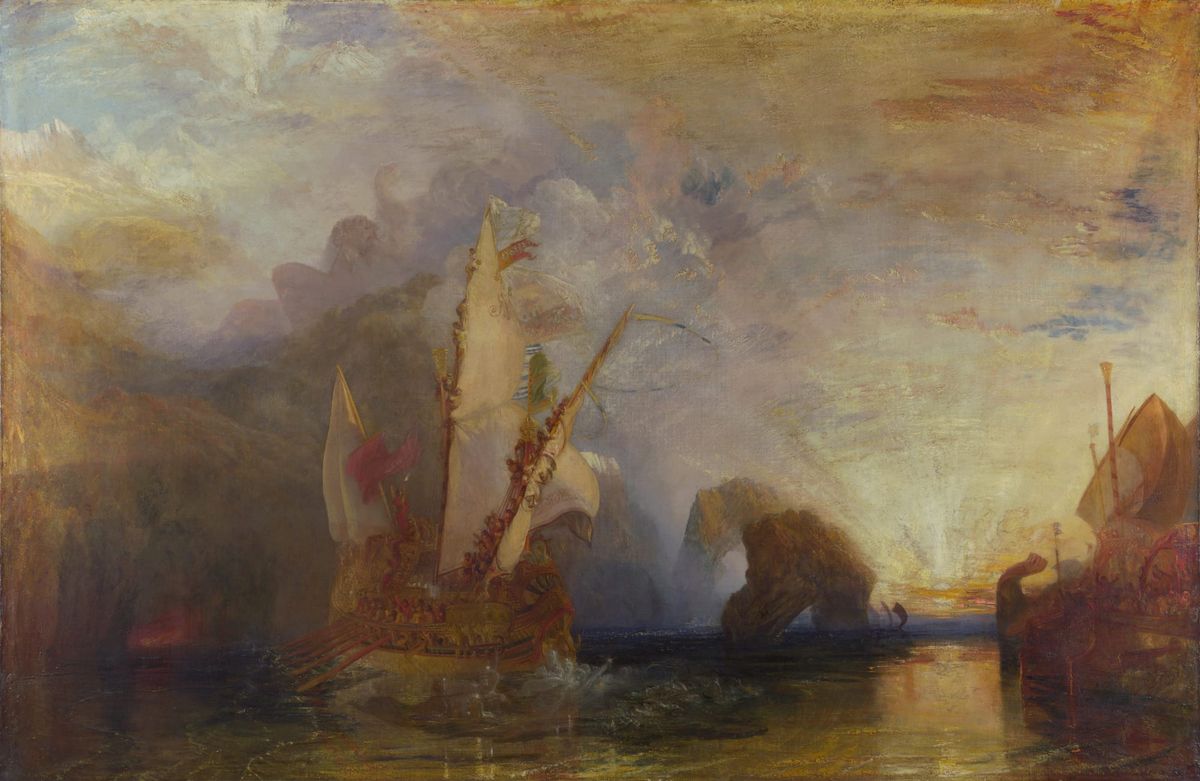
It's the most brutal storm that has ever terrorized the Mediterranean. In its midst is one man trying to get home, a shabby raft the only thing keeping him from drowning. Even in his greatest peril, Odysseus does not break what he set out to do. He completely surrenders.
Until he gets thrown overboard.
This is it for the great hero. So close to home, the sea swallows him. Now not even hope remains, having fled the storm.
But because Odysseus didn't, instead of lying at the bottom of the sea, he wakes up at the shore of his island of Ithaca.
Odysseus' journey is symbolic of life. In order to overcome the greatest burdens thrown at him, he can't use the traits that made him formidable: he can't brute-force it with strength, nor can he outsmart the god of the sea. To finally get to the end – or at least the next stage – he must do what he fears most: surrender to life.
We might not be faced with Greek tragedy disaster in our lives, but we can learn something from the hero of legend: It's futile wanting to control the waves and currents we face. The only thing we can do is to go with the flow of water, controlling the rudder of our raft we cling to. Then the course will chart itself, and we will find our way home.