Why You Need To Break To Be Full


People don't love remaining the same quite as much as they hate changing.
Change goes against everything we were taught. In school, we're rewarded for being the same: learning the same, doing the same, acting the same. We swim in the monotony of sameness, and trying to be different stirs the water. At the beginning of life, deviating from the norm is akin to jumping off the life raft. Instead of drowning, the sharks come, circling us, ready to tear otherness apart, only to put us back together into our "proper form".
Yet this goes against the most core part of what it means to be human: changing in order to become who we truly are.
But it's not as easy as just fighting against the current of sameness. The external forces are the raging stream, but we're phenomenal at tying a stone around our ankle, dragging ourselves down into the depths. This makes the process of change so difficult: we don't just need to overcome external forces, but also win the battle within. Change breeds resistance because it needs effort to be overcome.
Alain de Botton from the School Of Life has this wisdom I really love (read "men" as "people"):
"I think the best men are those who've been broken by life and have pulled through, have come out the other end. Why? Because they've been forced by circumstances to drop the illusion of their strength and they've known that they couldn't keep that going. They've hit rock bottom and they've had to reach out and say, I can't cope. 'I am in an infantile position. Help me.'
Men become rather glorious when that's happened to them. Because that's when there's true humanity, sympathy, etc.
But some men, they never get there. It's posture, posture, posture. It's defensive posture all the way. And I can spot them a mile away, the men who've been broken. You just sense that there's a modesty, deep down there's a modesty. And you just feel, I think people give off, I often notice it, a sense of how much you could tell them and how much they'd be able to bear."
When you break and come through to the other end, you're a new person entirely. Most of all, I think, you're freer than before. You can let go of some personas you had to play on the stage of life.
In storytelling, there are what are called the character archetypes. For example, Frodo from the Lord Of The Rings is a protagonist.
But there are many archetypes, and herein lies the problem: most people think they were broken and have found themselves when they have actually adopted an archetype.
What we love as an audience is if the character is relatable. That's the power of archetypes, because we carry many archetypes in ourselves. We've felt some of the struggles the character goes through.
But.
When a character is only an archetype and nothing more, the character becomes a tool – a plot device used by the author. The character is more a screwdriver than something else: it gets the job done to then be tossed aside.
It's the same with people. Instead of walking the arduous (and painful) path of finding our true selves to the end, we adopt an archetype which was given to us by somebody else so we can be done with it. But becoming an archetype and nothing else leaves 95% of our being aside, and instead of the main character of our lives, we become a caricature of ourselves.
A person is much more than an archetype. We carry many archetypes within us. That's why "finding yourself" is such a trap. What people mean by "finding yourself" is being authentic. They speak of the core of a human being – the unchangeable part of what makes you, well, you. I believe this part will not change in your lifetime.
But "finding yourself" is a problem when it makes you rigid. Because the concept of finding suggests an end to the process. Yet this is the opposite to what it means to be human. It's like Mother Earth:
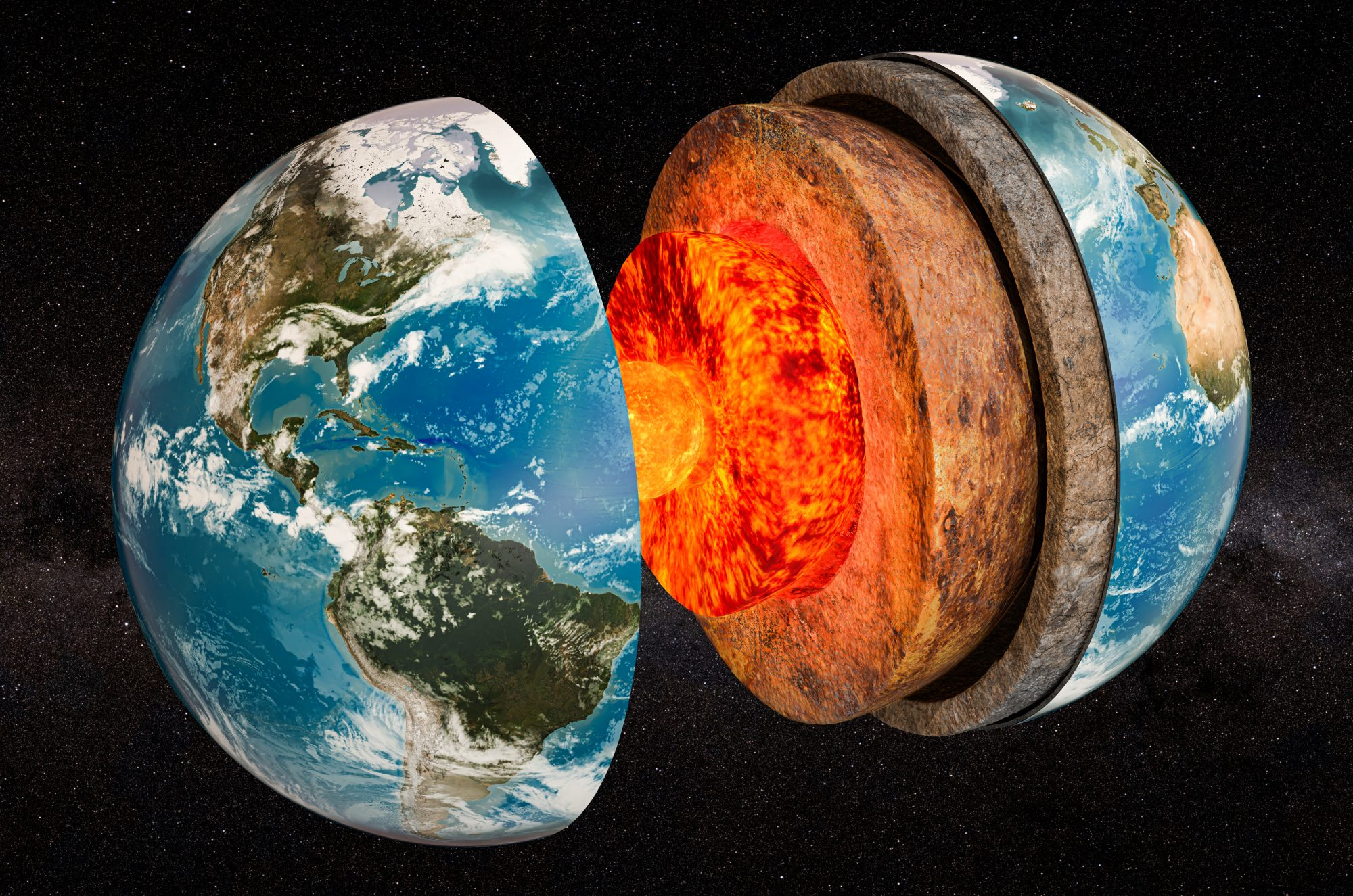
Her core is out of solid metal, yet the rest of our beautiful home is malleable: molten stone rages on the inside, the ocean's waters flow with the tide, and tectonic shifts change whole continents over the millennia. The essence of the magnificent blue marble remains, yet her beauty transforms over time.
It's the same with us: our essence remains steadfast, but the rest of us is in constant flux. Yet like the quote from Alain de Botton shows: this is uncomfortable. Change almost always is – but that's because we humans don't like change to begin with, even though it might be good for us. Where change may lead is undetermined, and that can be anxiety-inducing.
But it's also exciting and, most of all, good for us. It's a great sign because it points to one thing: evolution.
As Darwin found out two hundred years ago, it's not survival of the strongest, nor survival of the smartest, and it sure as heck is not survival of the steadiest. The winner, in nature and in life, is the one who can adapt, who can change.
Just like Mother Earth, we don't become less authentic when we change, on the contrary: only through evolution do we get to become our truest selves. But just like our planet, this comes with painful change. We might first have to get ripped apart to see who we truly are. Yet when we allow the wounds to heal, we find, instead of scars, our transformed selves, emblazoned with authenticity and truth – the ones we were always meant to be.