
Startup Stories – The Number One Startup Skill


It's my first rodeo working for a startup, and I'm struggling to stay in the saddle. Everything, everywhere, all at once. Tasks come in from left and right. I don't know where to start. But then I remember something I've used multiple times before. A technique that didn't just help people in offices, but a US president: the Eisenhower Matrix.
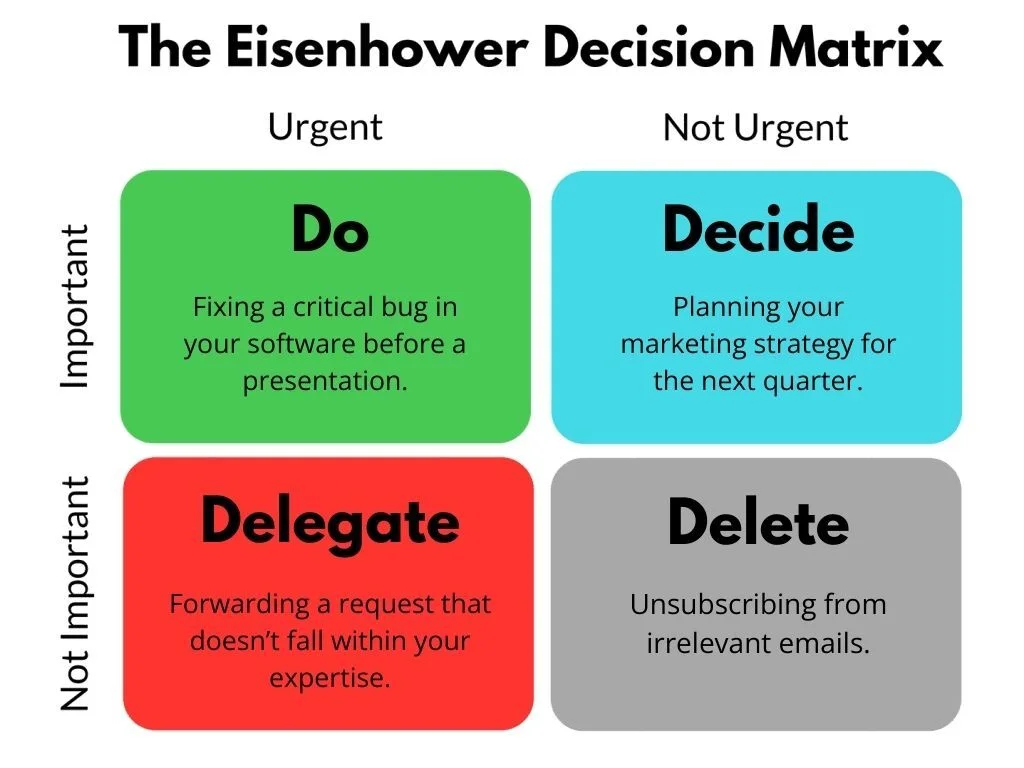
The Eisenhower matrix is a priority-setting tool. It categorizes tasks by their urgency and importance. For example, if a task is urgent and important, it lands in the Do-category. If something's not important but urgent, then delegate.
The perfect tool for my abysmal situation.
That's why I use the Eisenhower Matrix to get an overview of my first-day-fiasco. When I'm done grouping my tasks, a wave of relief washes over me. It feels like I've won – and that's where people fall into the maw of planning-dopamine.
Structuring may give you a quick dopamine hit, but it isn't the same as doing the tasks.
The beauty about working for a startup is the impact of your work. If you do something, it's immediately felt by the whole organization. In a smaller team, the input of a single individual yields a much higher percentage of the overall output. Yet the opposite is also true: if I don't do my tasks, it's all the more detrimental for everybody on my team.
We're only six people in the core team. My input matters. But the deadline is approaching. If I don't start now, I'll never make it. No chance.
Then I realize what the most important skill in a startup is. It's not understanding the market perfectly. It's not even creating the best product. The single greatest skill to be successful with a startup is agency.
Startups have a speck of the cash and capital of a corporation and they don't have the workforce who can carry other people on their shoulders. Whether you do something or don't, it matters much more in a startup. That's a lot of pressure, and some people despise it.
I think it's one of the greatest things ever invented.
Yes, there's a downside. But that's the human negativity bias speaking, drowning out the much more important noise: the upside. When you solve a problem with leverage for a startup, you can shoot your whole team into the stratosphere. Be it automations, a great ad campaign, an idea for a product, and much more. When you're done worrying about what could go wrong, focus on what could go right, then go build it.
Especially in today's world with all the great tools for free at your fingertips, one good decision can give you wings while everybody else flounders around in the dirt. But to test these wings you must be ready to jump off a cliff and see if you take flight.
You might find out that you've built a parachute instead. This is great news, because you've already gathered feedback – something you can only do if you're willing to fall. Failing is a byproduct of agency, but so is testing. And if you're testing, you can build a feedback loop. This feedback loop becomes your vehicle for learning, which then lets you iterate rapidly on your idea.
The problem with failing is that it also has a shadow usually much larger than its light: fear and anxiety. They are useful emotions, but they're even better liars. Testing out an app idea, automation, or social media ad campaign isn't the same as facing a sabretooth tiger, but our brains haven't made that realization yet. It's not even the sabretooth tiger we're afraid of. It's getting thrown out of the tribe.
This is the exact fear I had to face every single day after fulfilling a dream of mine.
When I came back from my world travel, I thought getting a new job would be smooth sailing. It was anything but. Every single day felt like I was capsizing. I sent out over 150 applications. Instead of interest or validation, the only thing I received were negative feedbacks or no answer at all.
"After checking your application..." "We regret to inform you that..." These sentences haunted my nightmares. Failing to get work is one of the most horrible feelings I've ever had.
I could've quit. It was like getting punched by a heavyweight boxer over and over again. What saved me from a knockout wasn't a stroke of luck. It was agency. I didn't quit sending out applications until the right opportunity arrived.
Now, I'm working for a startup that I love with work that fully engages me – just because I developed a bias towards action. And it's exactly this mindset that lets me thrive in this environment. When you've felt unwanted while having financial worries once in your life, trying out this new idea isn't so scary anymore. Paradoxically, not fearing failure is what makes you successful. But bravery is only part of the equation. In the end, it comes down to the same thing: a bias towards action.