Twenty Years of Living with Death

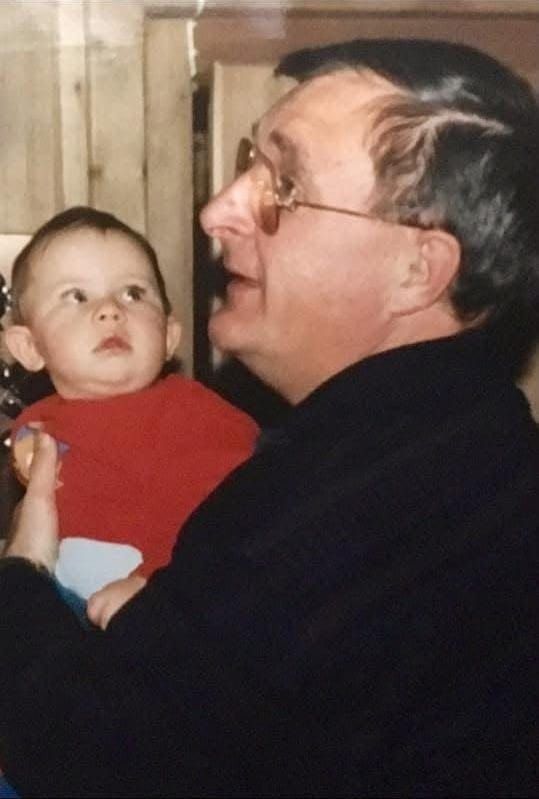
My childhood ended when I was six years old, and it all came to a close in this one room. This goddamn, sterile room.
Walls white upon white, with bright lights. I grab my elbow with my hand. Standing in this semi-hug, I start fidgeting around. Moving helps me holding back the tears. Being in here makes me want to take a shower.
This cursed room. Never has something so clean made me feel so dirty.
But it's not the room that instills the most fear in me. What I'm terrified of is looking at what stands right beside the window.
I'm staring at the ground when a flush of courage courses through my small body. I try to tilt my head up so I can finally look at it. I get to its four wooden legs. I can't make it any further without the tears defeating me.
I try again. No chance. I must be the first person in existence horrified of looking at a bed.
I don't think I can hold back the tears any longer. But instead of my floodgates, the door opens. In comes a man in a white coat. I'm told they're some kind of heroes and have to be respected. I don't know why. To me, they're harbingers of terror.
The white-coated hero smiles. It's one of those smiles that hide something. Something sinister.
I take a deep breath. That helped. The welling of tears starts to disappear. Maybe now I have finally the courage to do what I've been avoiding. Perhaps I can look at the person laying on the bed in the room – my grandfather.
Not-so-pleasant pleasantries are exchanged, and the man in the white coat I've now been told is a doctor starts speaking to my grandfather. The smile fades, and the doctor's forehead wrinkles. A much more stern look than before.
I hear the c-word once, then a second time. I don't know what it means exactly. I'm six years old, so I don't know a lot anyway. But my heart tells me it's something bad. Something very bad.
During the conversation, I start picking up pieces. Now it's clear to me: my grandfather has the c-word, and it's something horrible.
This perfect, sterile, unholy white again. As though its nothingness would eradicate the disease ravaging my grandfather.
Then the doctor spoke the words that would bring my childhood to an end: "Mr. Tribolet, you still have cancer."
The next six years were some of the most anxious and infuriating of my life. When someone close to you has cancer, you're always on edge. It's the most horrible roller coaster you can be on: the highs are very high, sprinkled with hope. The lows are abysmal, every time ripping your heart apart anew.
I don't remember my grandfather's face during the hospital visits – I never looked him into his eyes. It's only now I realize why: I was scared of what I'd find in them.
Fear? Sadness? Or, worst of all: good cheer?
Knowing him, it would've been good cheer, and that would've broken me. Seeing bravery from the people who'd need it from others is true strength, but it grinds you down even more because you feel like you're letting them down. Crying doesn't make the sick grow healthy, nor do you want to burden them with your suffering. In their moment of peril, they somehow find enough strength to give some of it to the people around them.
Then, after a hard-fought battle, my grandfather was finally allowed to lay down his weapons and rest.
This was on this day, twenty years ago.
I still can't quite believe how fast this time passed. Even twenty years without a person can go by fast. My grandfather has been gone much longer than I've known him. It's weird how a person can be gone for more than half your life and yet he or she is still on your mind daily.
But how? What is it that the essence of these people remain with you after they've left this world behind?
I thought I missed my grandpa because his humor, wit, and prowess. But that's not the case. It was because of something much more sacred, and much more painful. A particular kind of quality keeps them alive, and it's not our memory of them: the people who never leave were the ones who saw you for who you truly are.
I couldn't sit still as a child. This restless energy turned into sprints, storytelling sessions with my favorite action figures, and climbing competitions with imaginary monkeys. That energy didn't just evaporate on the dinner table. Sitting still, this energy released itself in a lot of blabla and many questions. But most of all, I turned to what I deemed "funny behavior" at the time. In other words, I loved testing out borders more than Napoleon back in the day.
Not that I was impudent. It was just that I had what seemed boundless energy. But not everybody was fond of my character traits. But the one who always loved me for it was my grandpa. Looking back, I don't remember a single instance he criticized one of the character traits that made me, well, me.
He seemed to love that goofy side of me. This was always impressive to me, because he had such a demanding job where he had to be able to make hard decisions. During his illness, he still led our family business, a car dealership. At the height of our family business, it had over 200 employees. Over 200 people, all with family and friends, who relied on my grandfather to make the right decisions and keep the business going. I don't think we can understand how heavy this burden is until we've carried it ourselves.
Yet when it came to me, he turned into the biggest goofball and entertainer.
When we goofed around, it felt as though he put his stone of Sisyphus to the side. Just for a brief respite, everything felt light.
Being able to carry a heavy burden lightly might be the key to life, and my grandfather knew how to make it open doors for him. One was the one to my heart. For a time, I was scared that with him passing, he would take the door out again.
Only, he's never left. How can we say someone we love has left us when they're in our hearts every day of our lives? They might not be here physically, yet their essence remains. How is asking for advice and knowing what advice they would give different? Even the feeling I get when thinking about my grandfather stays the same. It's as if he were standing right beside me. In truth, the people we love never truly leave. They're right there, beside us – they've only changed forms. They're the decisions we make, the things we enjoy, the longing we feel.
Life's not as sterile as the room where I understood I'd lose one of my favorite people. It's messy and unpredictable. But it's our choice if we complain about the mess of it all, or learn to enjoy it. It's in our power to see life as muddy water needing to be trotted through, or a wave we can surf on. My grandfather decided to ride the wave. Even when life threw this horrible disease at him, and everybody would've understood when he just lay down and quit, he didn't put his head under water. Instead, he kept surfing on his surfboard of good cheer, until his wave dissipated – right until the very end.
In the words of Michel de Montaigne:
“The most certain sign of wisdom is continual cheerfulness; her state is like that of things in the regions above the moon, always clear and serene.”