Follow Your Bliss(ters)

Joseph Campbell led an ordinary life, until he followed one of his great interests: he loved myths of old. What really got him going was reading all about these stories our ancestors told. This lit a burning question in him: why do we as a species tell stories – and why are they so similar around the globe?
After reading myth after myth, he realized there was an inherent structure to all these stories. It didn't even matter from which culture the myth originated. All over the globe, they had the same foundation, took similar paths, and peaked in endings resembling each other. That's how the famous Hero's Journey was born:
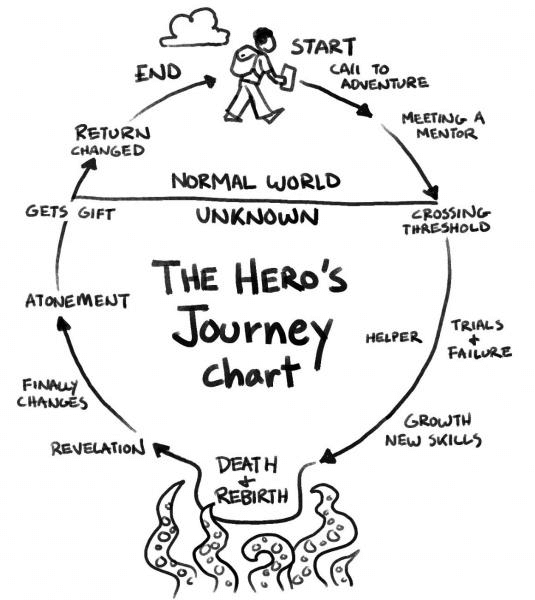
At its core, The Hero's Journey is a representation about the transformation of the hero. The hero starts in their ordinary world, but is thrust out of it. During the trials and tribulations they face, transformation happens, changing the hero in the process.
It's now the go-to formula for storytellers all over the world – be it a friend telling a story around a table, someone writing a branding campaign for business, or some of the greatest filmmakers of our time.
Just because one man followed something he was deeply interested in. But that's not how Campbell's story ends.
When Campbell was an old man, he was asked during an interview what he learned about living a good life. First, he answered "follow your bliss". For him, this was reading all these myths of old. But then followed up with something that's now burned into my mind: "follow your blisters".
But why follow your blisters?
Because whatever you choose, it will hurt anyway. Pain is not a bug, but a feature. Ask the musician playing the tenth concert in a row how much joy music brings them when their fingers bleed from playing so much. Is the entrepreneur feeling joyful at 3 am, not knowing if they can make payroll?
But – and this is a humongous but – if you already know you will suffer, then why not pick something you enjoy? Suffering for something is much easier if that something brings you joy – at least to some degree.
I'm not saying quit your job today and become a professional puppeteer tomorrow. Introducing joy into your life is similar to mithridatization: a little dose of joy daily, then increase the dosage gradually. if you have been deprived of joy for so long, having everything at once might end deadly. Your system can't handle it. Joy becomes the culprit, because it's actually mania in disguise.
When you're willing to suffer for something, you already have a competitive advantage. You simply become harder to compete against because you're willing to endure pain others aren't. What might be a slog for some is pure bliss to you. Do you really want to compete against someone who does something with joy while you have to trudge through every single time? It's like fighting an uphill battle but instead of only facing your enemy an avalanche is thundering your way.
When you really want to know your blisters, you must know yourself. But you cannot know yourself without having empathy for you. Getting to know one's self is to be empathetic with the human you are. It's as if going on your own hero's journey, and the mountain is not the challenge of pursuit, but the fright of looking inward. But if you do, you'll be able to charter your own path up the mountain. Then you will enjoy the climb and be grateful for the blisters on your feet, because they're of your own choosing.